Documents
- Store all project files, plans, specs and contracts, in one clear place.
- Notify clients when new documents are uploaded.
- Track views to see who accessed each document.
- Clients always find the latest version, no confusion.


Letsbuild and Ziggu connect through Ziggu's public REST API. The snags your site team records reach Ziggu daily, where you decide which ones to publish to the buyer. From there the buyer follows the points on their own home, reports new ones, and confirms a repair when it is done. That confirmation travels back to Letsbuild. Five property developers run this today: Immobel, ION, AG Real Estate, Vesta and Nextensa.
Letsbuild is built for the people on site. It carries every point on every unit, in shorthand, with the internal statuses your team needs to run the work. A buyer reading that does not get reassurance, they get questions, and they see work in progress that was never meant for them.
The usual alternative is email, and email is worse. A buyer reporting a loose socket sends it to whoever they last spoke to, that person forwards it, and three messages later somebody has to remember to check whether it was done. Multiply by two hundred apartments.
Ziggu is the layer in between. The buyer sees the points you published, on their own home, in language written for them. See Reports.
The daily sync brings points into Ziggu. It does not put them in front of the buyer. Someone on your team publishes them, and that gap is deliberate: a point logged at eight in the morning with a photo and three words is not what you want a buyer reading at nine.
That gives you two separate controls. Publishing decides when a buyer sees a point. Access per report decides who sees it, which is what keeps buyer A out of buyer B's punch list on the same floor.
In Ziggu you can ask the buyer to confirm a point is resolved. They press one button, and that confirmation goes back to Letsbuild so your site team sees it where they work.
The value is not the click. It is that at the provisional handover, and again a year later, nobody is arguing about whether something was fixed. The buyer said so, in writing, at the time.
The first column is the name your team knows from the app, the second is the endpoint the connection writes to.
| What it is in Ziggu | Endpoint | Direction | When |
|---|---|---|---|
| Snags, as points in a Ziggu report | /issues | Letsbuild to Ziggu | Daily, then published by your team |
| The list a point belongs to | /issue_lists | Letsbuild to Ziggu | With the point |
| Category and status | /issue_categories, /issue_statuses | Mapped both ways | With the point |
| A point the buyer reported, for your team to review | /issues | Created in Ziggu | Pushed to Letsbuild once reviewed |
| A point the buyer confirmed as resolved | /issue_statuses | Ziggu to Letsbuild | Daily |
| The unit the point belongs to, and the project above it | /units, /projects | Matched, not created | With the point |
Three routes, same API underneath. Pick the one that matches who is going to maintain it.
Whichever route you take, the mapping decision comes first: which Letsbuild project corresponds to which Ziggu project, and how a point finds the right unit inside it. On a development with two hundred apartments that is the whole job, because every buyer has to see their own points and nobody else's. Settle it, run it on one building, and look at what a buyer would see before you widen it.
The points recorded at handover are already in Letsbuild. Published to Ziggu, each buyer sees their own list and confirms what has been fixed, so the list closes itself instead of being chased by phone.
Buyers notice things after they move in. In Ziggu they report them against their own home, with a photo, and your team decides whether it belongs in Letsbuild. See how property developers use Ziggu.
Contractors work in Letsbuild, which has no conversation with the buyer in it. When a partner needs to arrange an appointment directly, you can give that partner a Ziggu account instead of a phone number, and the exchange stays on the project.
Immobel, ION, AG Real Estate, Vesta and Nextensa.
No. Nothing is visible until your team publishes it, and access is set per report, so a buyer sees their own home and not their neighbour's.
Yes, in Ziggu, against their own unit. Your team reviews it and pushes it into Letsbuild if it belongs there.
Yes, and that confirmation goes back to Letsbuild as a status update. One button for them, a written record for you.
Points sync daily. After that a buyer sees it as soon as your team publishes it.
Usually not. Partners work in Letsbuild. Give a partner a Ziggu account when you want them talking to the buyer directly, for instance to arrange an appointment, because Letsbuild has no conversation with the buyer in it.
Same kind of route. See Archisnapper and Ziggu.
Last verified: 28 August 2026.
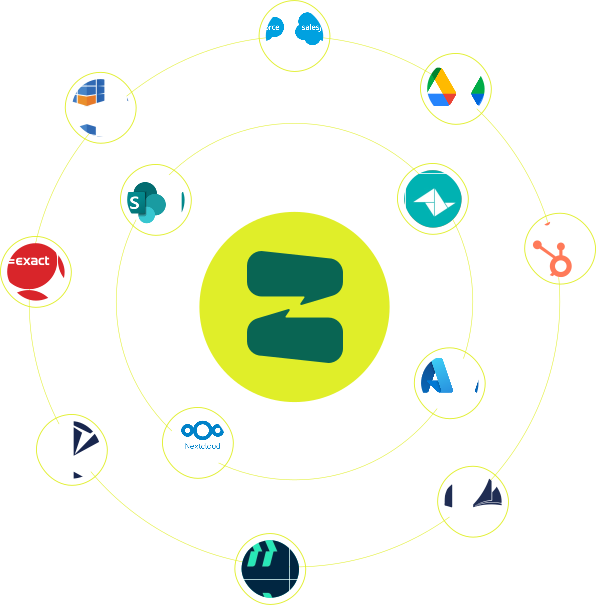
Ziggu already integrates seamlessly with a number of CRM, ERP and document management systems. Can't find yours? Contact us and we'll research the possibilities!
CONTACT US
