Documents
- Store all project files, plans, specs and contracts, in one clear place.
- Notify clients when new documents are uploaded.
- Track views to see who accessed each document.
- Clients always find the latest version, no confusion.


Teamleader Focus and Ziggu connect through Ziggu's public REST API. A deal that reaches the stage you choose becomes a Ziggu project with its contacts attached, and quotations and invoices arrive as decisions and instalments. The point is not that the data moves. The point is that your client stops hunting: every choice on the project, your quotation and everything that follows it, waits in one client portal instead of scattered across your quoting tool, your mailbox and a shared drive.
Teamleader already sends a quotation, and the client can already sign it there. So the reason to connect is not the quotation. It is everything around it.
On a project with any customisation in it, a client does not make one decision. They approve the proposal, and then whatever your work requires after it: a drawing, a specification, a material, a change during the job, a report at the end. The list depends on your trade. The shape does not. If the proposal lives in your quoting tool and the rest lives in email, the client has two places to look and you have a follow-up problem.
Bringing the Teamleader quotation into Ziggu's decisions puts the whole sequence in one list, in the order it has to happen. The electronic signature stays where it belongs: Ziggu shows the decision, and the link on it opens the Teamleader signature app, so you keep the signing flow you already trust and the client still only opens one app. See Decisions and Approvals.
Ziggu organises work as projects, and a project can hold one unit or hundreds. A unit is the smallest thing a single client has: one apartment in a development, one house, one fit-out, one order. Between project and unit sit optional levels, phases and lots and buildings, which large projects use and small ones never see.
If you run one job per client, which is how most Teamleader users work, your project and your unit are the same record and those levels stay invisible. That is worth knowing before you agree the mapping, because it decides what a Teamleader deal has to become.
Written into Ziggu through the public API. The first column is the name your team knows from the app, the second is the endpoint your developer will actually call.
| What it is in Ziggu | Endpoint | Direction | When |
|---|---|---|---|
| Contacts and the companies behind them | /customers, /companies | Teamleader to Ziggu | Every scheduled run |
| A deal that reached your chosen stage, as a new project | /projects | Teamleader to Ziggu | First run after the stage change |
| The contacts linked to that deal, attached to the project | /unit_customers | Teamleader to Ziggu | With the project |
| Quotations, as decisions with the options offered and a link to sign in Teamleader | /decisions, /proposals | Teamleader to Ziggu | Every scheduled run |
| Invoices, as instalments | /installments | Teamleader to Ziggu | Every scheduled run |
| The invitation to the portal | Sent from Ziggu by your team | Manual | When you decide the portal is ready |
Three routes, same API underneath. Pick the one that matches who is going to maintain it.
Whichever route you take, three decisions come first: which deal stage creates the project, which Teamleader fields land where in Ziggu, and how often it runs. Settle those, run it once against a single deal, and check the project, the contacts, the decisions and the instalments before you point it at the whole pipeline.
The proposal comes from Teamleader. Everything the client has to approve after it does not. In Ziggu they queue up as one list the client works through, which is what stops the same client emailing you to ask what they still have to approve.
Sales works in Teamleader and stops there. The client, the contacts and the agreed scope are already in Ziggu when the delivery team opens the project. Nobody copies a contact into a second system, and nobody starts a project on an out of date address.
Because the trigger is a deal stage, the handover happens the same way every time. No project starts because someone remembered to start it. See how architects and contractors use Ziggu.
No. The connection runs on Ziggu's public REST API. You build it, a partner builds it, or you deploy a template on Peliqan.
A deal reaching the stage you nominate. The project appears on the next scheduled run.
Yes. The decision in Ziggu carries a link that opens the Teamleader signature app, so the signing flow does not change and the client still only opens one app.
Because the quotation is one of many decisions on a project that is not off the shelf. Drawings, specifications, materials, changes and delivery reports all need an answer too. In Ziggu they sit in one list the client works through, in order.
No. The connection creates the project and attaches the contacts; someone on your team sends the invitation from Ziggu once the portal is ready to be seen.
Not in the direction described here. This connection moves data from Teamleader into Ziggu.
The same API serves HubSpot, Salesforce and Zoho.
Last verified: 28 August 2026.
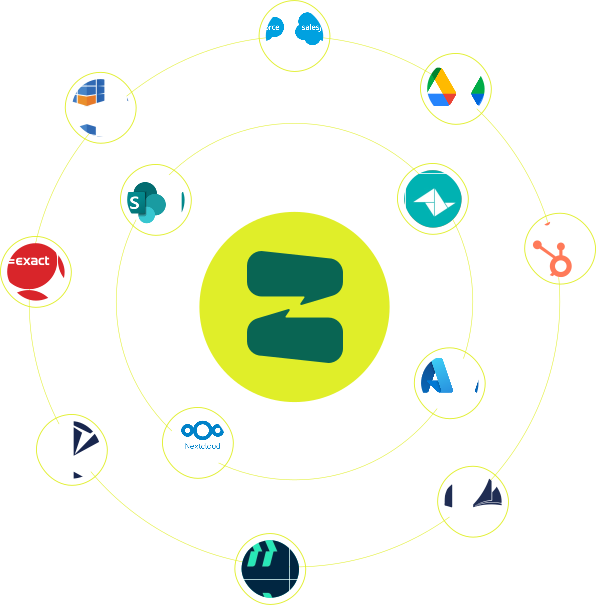
Ziggu already integrates seamlessly with a number of CRM, ERP and document management systems. Can't find yours? Contact us and we'll research the possibilities!
CONTACT US
