How to Scale Customer Care as a Growing Property Developer
Growing residential developers can scale customer care by automating repetitive tasks and centralizing communication, allowing advisors to focus on high-value activities like design consultation.
Follow us for more content
Growing residential developers can scale customer care efficiently by automating repetitive tasks and centralizing homebuyer communication through digital platforms. This approach frees customer advisors to focus on high-value activities like design consultation and relationship building, while maintaining exceptional service quality across an expanding project pipeline.
Common Scaling Challenges and Automation Solutions
When residential developers expand their project portfolios, customer care teams often hit a wall. More homebuyers mean more questions, more documents to track, and more deadlines to manage.
The typical response? Rush through each interaction or hire more staff. Neither solution addresses the core problem: time wasted on administrative tasks that don't add value for homebuyers.
Customer advisors find themselves buried in Excel updates, hunting through endless email chains, and answering identical questions repeatedly. Meanwhile, homebuyers notice their advisors seem distracted and pressed for time.
Smart developers focus their teams on activities that genuinely matter to homebuyers. Customer advisors excel at design consultation, construction coordination, and relationship management — not data entry.
Automation handles the repetitive work. FAQ builders answer common questions instantly. Automatic deadline reminders keep project timelines on track. Digital approval workflows send signed plans directly to contractors without manual intervention.
The result? Customer advisors spend their time where they add the most value. This shift from reactive customer service to proactive customer experience management creates lasting competitive advantages.
Traditional Approach
Digital Portal Solution
Manual document searches
Instant document access via portal
Email chains for updates
Automated project notifications
Repetitive FAQ responses
Self-service knowledge base
Time spent on admin tasks
Focus on relationship building
Information scattered across channels
Centralized communication hub
"We can put more emphasis on customer experience thanks to our Ziggu platform" Stefanie Vanden BrouckeCEO CAAAP
Creating Customer Stories Through Centralized Communication
CAAAP's experience illustrates how centralized platforms transform customer care scaling. Their team previously struggled with scattered information across multiple channels.
"We had been struggling with the abundance of information shared between customer and developer," explains former CEO Stefanie Vanden Broucke. "Sometimes it was like looking for a needle in a haystack to find a document for a client."
Knowledge gaps emerged whenever team members left. New support staff couldn't quickly understand project histories or customer preferences.
Centralizing all homebuyer communication and project documents solved these problems. But it also created something more valuable: time for storytelling.
"For us, it's not just about customer satisfaction; it's also about customer experience," says Vanden Broucke. "Updates about the building location, 'get to know the team' posts or fun places near the site: these are all small elements that create a bigger story around the project."
These personal touches resonate powerfully with homebuyers. Some become genuine project ambassadors, sharing their positive experiences with friends and family.
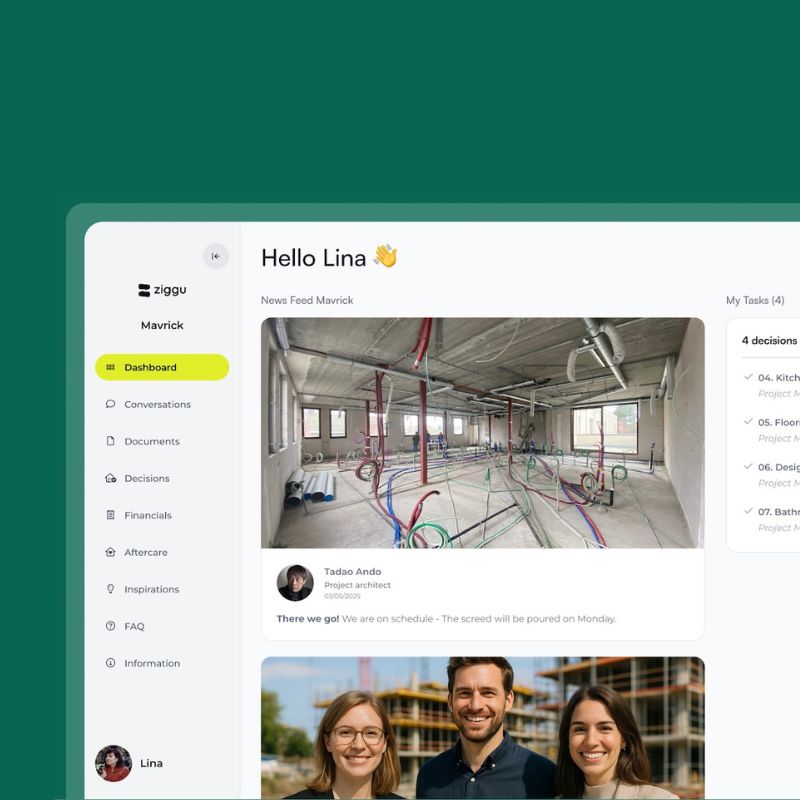
This transformation only happens when administrative burdens lift from customer care teams. Automation creates space for the human connections that drive loyalty and referrals. Modern customer portals serve as the new website for project communication, providing homebuyers with instant access to their project information.
Impression of the CAAAP customer portal
Implementation Strategy and Business Benefits
Start by identifying your team's most time-consuming repetitive tasks. Common culprits include document searches, status update requests, and basic project information queries.
Map these tasks to automation opportunities. FAQ builders handle routine questions. Notification systems keep everyone updated automatically. Document portals eliminate search time. For developers managing multiple projects simultaneously, implementing efficient large-scale project management strategies becomes essential for maintaining service quality.
Measure the impact on both customer satisfaction and team efficiency. Track time savings and monitor how your advisors spend their newly available hours.
Prerequisites for Successful Implementation
Before implementing customer care automation, ensure your team has clear processes documented for common customer interactions. Establish baseline metrics for response times and customer satisfaction scores. Most, secure buy-in from customer advisors by demonstrating how automation will enhance than replace their role.
Scaling customer care through automation isn't just about efficiency — it's about competitive advantage. Developers who maintain personal relationships while managing larger project volumes win more referrals and repeat business.
Your customer advisors want to build relationships and solve complex problems. Give them the tools to focus on these high-value activities, and both your team satisfaction and customer loyalty will improve.
The choice is clear: automate the routine work, or watch your customer experience suffer as you grow. Smart developers choose automation and let their teams shine where they add real value.
Written by Vincent Van Impe
Vincent is co-founder of Ziggu, the project management software for client work, where he leads sales and marketing. Ziggu gives project-based businesses - property developers, architects, creative agencies, manufacturers and more - one place to run long, milestone-driven projects with clients and partners in the loop: milestones, tasks, decisions and approvals, and project conversations in a single dossier, paired with a client portal. With a background in architecture, project management and SaaS, Vincent writes about client experience, project delivery, and the future of project-based collaboration.