Homebuyer trust breaks in the quiet months after the signature
Homebuyer trust drops in the construction phase, where updates stop, and both public Google reviews and Ziggu research put the fall at the same point in the journey.
Follow us for more content
Homebuyers keep their trust when the news reaches them before they have to ask for it. The months between the signature and the keys are the ones in which a property developer normally goes quiet, and that silence is what buyers write about afterwards. Ziggu keeps the whole build in one customer portal, so project news, documents and answers sit where every buyer can find them without sending an email.
Key takeaways
Ziggu keeps new-build buyers informed through one customer portal, where project news, the milestone timeline and documents sit in the view buyers already check.
Trust in a property developer breaks after the contract is signed, because that is the phase in which the relationship normally goes quiet.
Buyers who write a bad public review rarely name a defect on its own: they name what happened after they reported it.
An update earns its place when it is short, aimed at the right building or unit, and written in the language the buyer reads.
Milestones give a construction project moments worth announcing, so buyers hear from a developer for reasons other than a delay.
Silence is what buyers complain about in public
Public complaints about property developers are mostly about not being answered, not about what was built.
In Ziggu's Google Review Study: Belgian Property Developers 2026, communication and reachability turned up in 44,6% of the 734 negative reviews in the sample, ahead of every other theme, including finishing quality.
Read those complaints one level deeper and the most named failure is a promise that was not kept, ahead of getting no answer at all and getting no update on status or planning.
A defect on its own rarely produced a one-star review. What turned it into one, in the reviewer's own telling, was what happened after they reported it.
The praise runs on the same theme from the other side. When buyers were happy, the thing they named most often was a person who answered.
That is worth knowing, because answering is the part a developer still controls in a month when nothing on site goes to plan. You cannot promise a roof by Friday. You can promise that the buyer hears it from you first.
How do you keep new-build buyers informed about the works without endless emails?
You keep new-build buyers informed by publishing updates in one customer portal instead of sending them, so every buyer reads the same message in the place where their documents, their choices and their questions already sit. Nothing has to be forwarded, and nothing lands in a mailbox where it competes with the rest of someone's week.
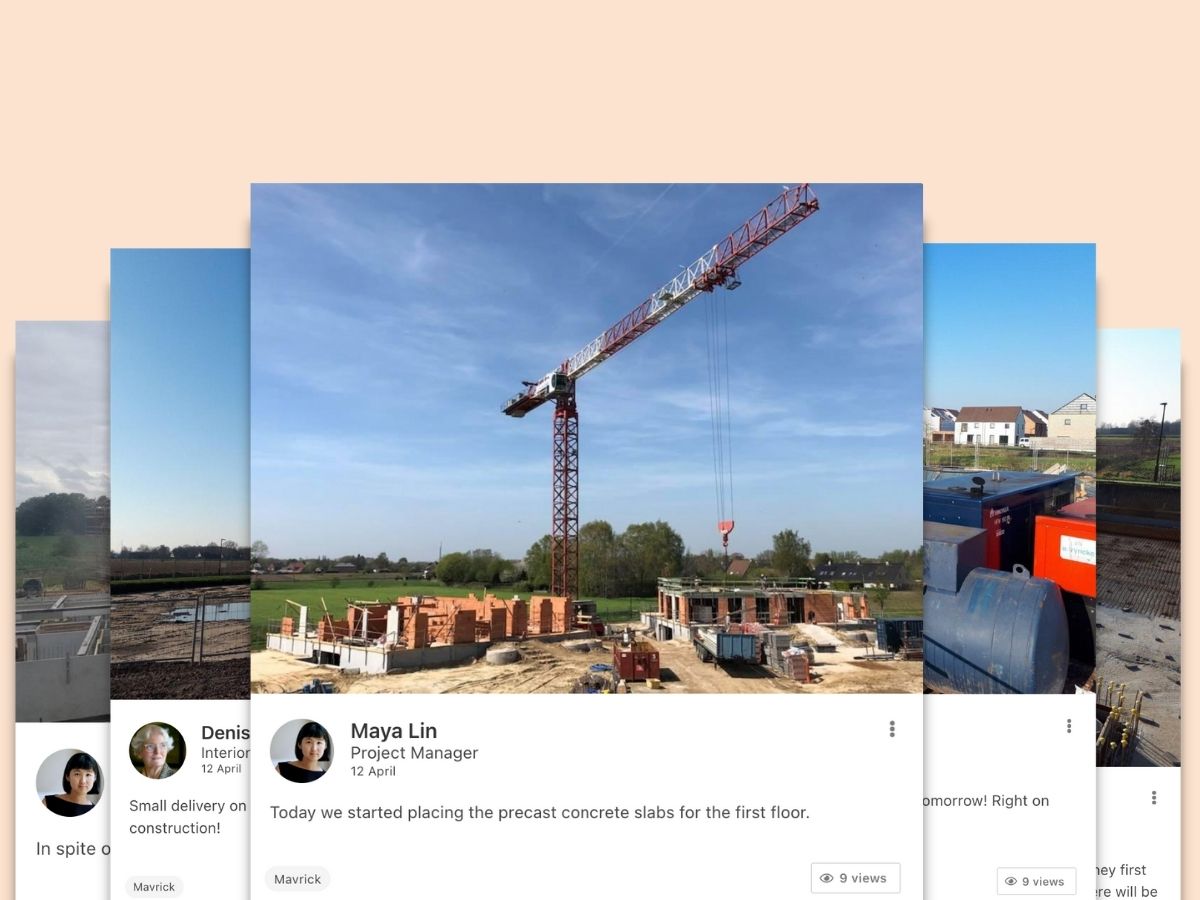
In Ziggu that view is Client Updates: project news, the milestone timeline, the financial state of the file and a FAQ library, all in one place per buyer.
Marc Wagner, owner and CEO of the Luxembourg property developer Polyform, describes what that changed for his team: “Ziggu also offers a very useful tool, the news feed. You can use it to share photos of the construction with your customers. We didn't share enough of those updates before Ziggu, because it was a cumbersome job, but now you only need a few clicks.”
Two things decide whether an update is worth publishing at all: whether it is relevant, and whether it is understood.
Relevance is a targeting problem. A delay in Building A announced to the buyers of Building B creates worry and nothing else. Updates can go to a whole project, to one building, or to a single unit, so nobody reads news that is not theirs.
Being understood is a language problem. Buyers read the update in the language they set, or in your company's default when a translation has not been added yet, and you can switch languages on the post itself to check what each buyer will see.
The drop sits in the construction phase, and it has now been measured twice
Satisfaction with a new-build purchase does not fall evenly across the purchase. It falls after the signature.
In Ziggu's Belgian Homebuyer Survey 2017, 76,4% of the 242 buyers surveyed were satisfied with the sales approach and 54,7% with how they were kept informed while the works ran.
The same survey split buyers by whether their developer offered a digital environment. Those who had one were more satisfied at every stage, and the difference was widest on progress during the works: 87,5% against 46,9%, on bases of 40 and 179 buyers. Read that as an association rather than a mechanism, on a small group: developers who already ran a digital environment in 2017 were probably better organised in other ways too.
Nine years later, public Google reviews drew the same curve with a different instrument.
Journey phase
Survey 2017: share satisfied
Reviews 2026: share of that theme negative
Before the signature
76,4% on the sales approach
36,0% on the sales experience
During construction
54,7% on progress updates
30,6% on communication and reachability
After the keys
Not measured
66,1% on aftercare and warranty
What belongs in an update, and what does not
An update earns publication when it tells a buyer something that changes what they do next, or lets them stop wondering.
Keep it to a few lines. Buyers scroll their updates the way they scroll a feed, and a project newsletter that reads like a chapter gets opened once.
Say when the next one is coming, and then send it when you said you would. A schedule that holds is worth more to a nervous buyer than any single message in it.
Milestones give buyers a reason to hear from you that is not a delay
Milestones turn a build into a sequence a buyer can follow, so the update stream carries progress as well as problems.
Foundations poured, roof closed, utilities connected: each one is a fixed point on the timeline in Client Updates, visible to the buyer without anyone writing an explanation of where the project stands.
They also give the good news somewhere to sit. A developer whose only announcements are corrections trains buyers to open updates with their shoulders up.
Damien Janssens de Bisthoven, project manager at BESIX RED, saw the effect on Project Oxygen in Auderghem: “When we offer our clients a more practical and accessible way to follow up on the progress of the construction (via photos, comments, …), we increase their sense of involvement and engagement which positively impacts their level of satisfaction. In return, those clients are reacting faster and making decisions more proactively.”
That is the part that pays for the effort. A buyer who has been following along answers a question about their kitchen in a day instead of three weeks, because they have been in the file the whole time.
Written by
Vincent Van Impe
Vincent Van Impe is a co-founder of Ziggu, where he leads sales and marketing. He has a background in architecture, project management and SaaS, and writes about client experience, project delivery, and how project-based businesses keep clients and partners in the loop.